 Image 1 of 1
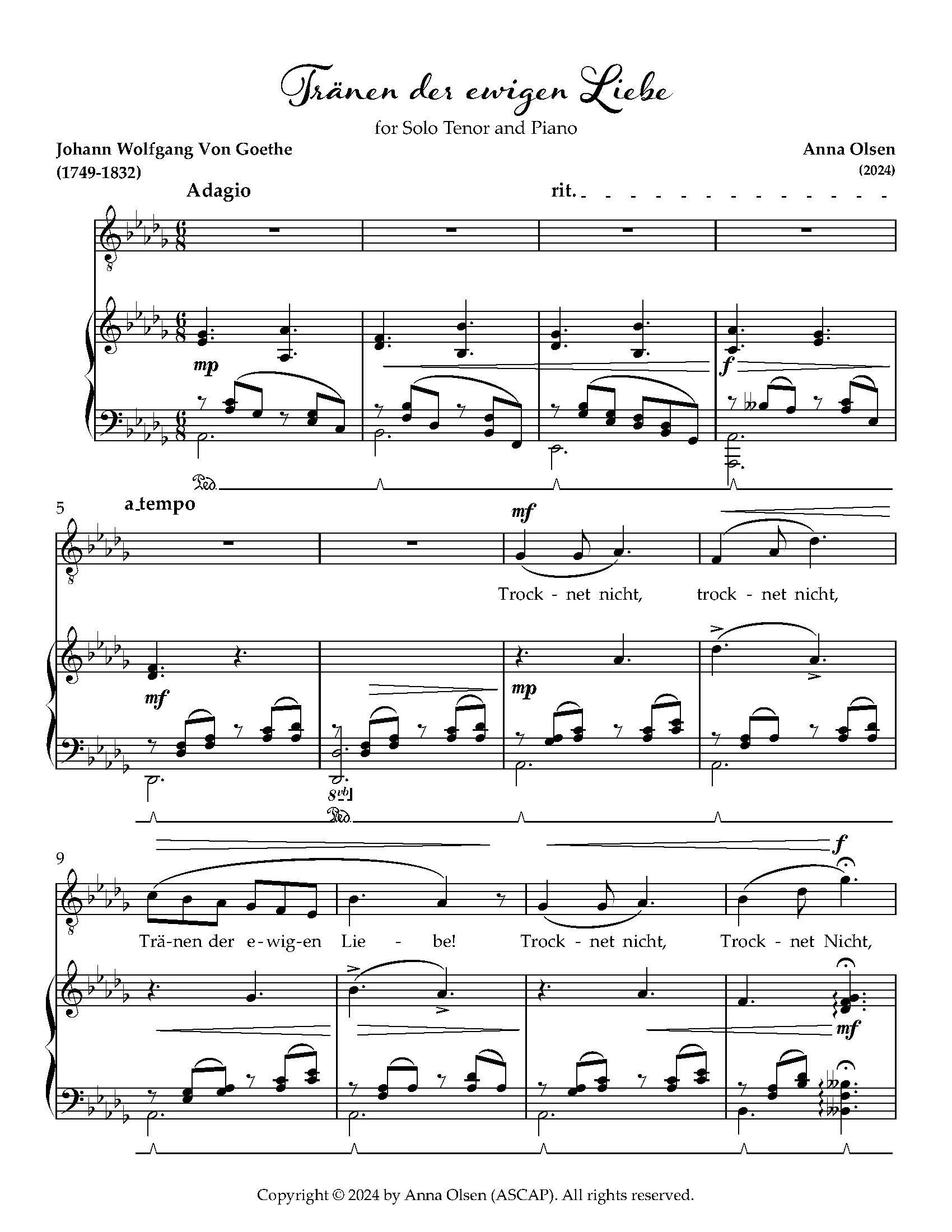
Johann Wolfgan von Goethe, the author of the text setting, was a prominent German writer around the time of the romantic era. He wrote a variety of texts, from political to philosophical. However, he was also very well-known for his poetry. I own a book of song-texts, and Goethe’s section of poetry takes up almost a third of the book. Many Romantic-Era composers wrote songs to his texts—so it was only natural for me to compose a song with one of his poems.
“Wonne der Wehmut”
German Text:
Trocknet nicht, trocknet nicht,
Tränen der ewigen Liebe,
Ach, nur dem halbgetrockneten Auge,
Wie öde, wie tot die Welt ihm erscheint!
Trocknet nicht, trocknet nicht,
Tränen unglücklicher Liebe.
Translation:
Do not dry up, do not dry up,
Tears of eternal love!
Oh, even to half-dried eyes,
How bleak, how dead the world appears to them!
Do not dry up, do not dry up,
Tears of unhappy love!
Johann Wolfgan von Goethe, the author of the text setting, was a prominent German writer around the time of the romantic era. He wrote a variety of texts, from political to philosophical. However, he was also very well-known for his poetry. I own a book of song-texts, and Goethe’s section of poetry takes up almost a third of the book. Many Romantic-Era composers wrote songs to his texts—so it was only natural for me to compose a song with one of his poems.
“Wonne der Wehmut”
German Text:
Trocknet nicht, trocknet nicht,
Tränen der ewigen Liebe,
Ach, nur dem halbgetrockneten Auge,
Wie öde, wie tot die Welt ihm erscheint!
Trocknet nicht, trocknet nicht,
Tränen unglücklicher Liebe.
Translation:
Do not dry up, do not dry up,
Tears of eternal love!
Oh, even to half-dried eyes,
How bleak, how dead the world appears to them!
Do not dry up, do not dry up,
Tears of unhappy love!